Overview
Implementation of Unified Extensible Firmware Interface (UEFI) by Vendors provide a way to customize logo image displayed during the early boot phase. Binarly has uncovered vulnerabilities in the image parsing libraries that provide this capability. An attacker with local privileged access can exploit these vulnerability to modify UEFI settings.
Description
UEFI firmware provides an extensible interface between an operating system and hardware platform. UEFI software stores a number of settings and files in a customized Extensible Firmware Interface (EFI) partition known as EFI system partition (ESP). ESP is a special privileged file system that is independent of the OS and essentially acts as the storage place for the UEFI boot loaders, applications, hardware drivers and customizable settings to be launched by the UEFI firmware. The ESP partition is mandatory for UEFI boot and is protected from unprivileged access. The information stored in ESP is probed and processed during the early phases of an UEFI based OS. One such information stored in the ESP is a personalizable boot logo.
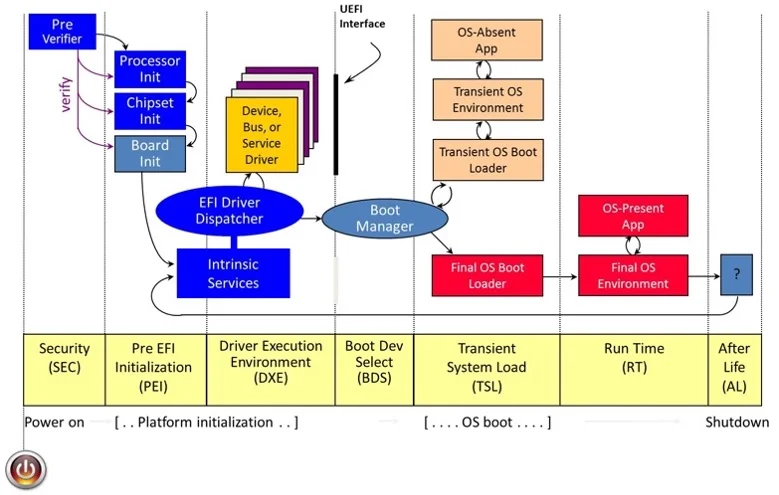
Binarly has discovered a number of vulnerabilities in the image parsing libraries that read and process these image files. As these files are processed by executables that run under a high privilege, it is possible to exploit these vulnerabilities in order to access and modify high-privileged UEFI settings of a device. UEFI supply-chain allows for many of these shared libraries to be integrated in various ways, including compiled from source, licensed for modification and reuse and finally as a dynamic or static linked executable. Binarly has also observed that in some cases an attacker can create a bundled firmware update that contains a corrupt or malicious image to trigger these vulnerabilities. This can also allow an attacker to exploit vulnerability while flashing the PCI with a firmware update. Due to the complex nature of these vulnerabilities and their potential wide impact, Binarly would like to use the label LogoFAIL to track and support coordination and mitigation of these vulnerabilities.
Note: Major Independent BIOS Vendors (IBV) have obtained CVE to track this set of vulnerabilities for their supply-chain partners and their customers.
| Binarly Advisory | CVE's | Primary Vendor |
| BRLY-2023-018 | [CVE-2023-39539](https://www.cve.org/CVERecord?id=CVE-2023-39539) | AMI |
| BRLY-2023-006 (1) | [CVE-2023-40238](https://www.cve.org/CVERecord?id=CVE-2023-40238) | Insyde |
| BRLY-2023-006 (2) | [CVE-2023-5058](https://www.cve.org/CVERecord?id=CVE-2023-5058) | Phoenix |
Please check the Vendor Information section for additional details provided by other vendors to address these issues.
Impact
The impacts of these vulnerabilities vary widely due to the nature of the UEFI software and various implementations through the supply-chain.
In summary, a local attacker with administrative privileges to the ESP partition or to the firmware flash can use malicious images to perform any of the following:
- Disable UEFI security features (SecureBoot)
- Modify the UEFI Boot Order or the designated Boot Partition
- Execute unwanted software to infect protected Operating System
In some cases, attacker can use the vendor provided logo customization interface to upload these malicious images.
Solution
Apply Updates
Multiple vendors from the supply-chain have provided their solution to these vulnerabilities and have provided software updates to address them. Please verify your vendor provided statement and their solution below with any reference or additional information to address this issue.
Acknowledgements
Thanks to Binarly for reporting these vulnerabilities. We would also like to thank multiple vendors from the UEFI supply-chain cooperated to address these issues
This document was written by Vijay Sarvepalli.
References
- https://uefi.org/specs/UEFI/2.10/33_Human_Interface_Infrastructure.html
- https://uefi.org/specs/UEFI/2.10/13_Protocols_Media_Access.html
- http://www.uefi.org/sites/default/files/resources/UEFI%202_5.pdf#page=536
- https://learn.microsoft.com/en-us/windows-hardware/manufacture/desktop/bcd-system-store-settings-for-uefi?view=windows-11
- https://binarly.io/posts/finding_logofail_the_dangers_of_image_parsing_during_system_boot/index.html
- https://www.insyde.com/security-pledge/SA-2023053
- https://9443417.fs1.hubspotusercontent-na1.net/hubfs/9443417/Security%20Advisories/AMI-SA-2023009.pdf
- https://www.phoenix.com/security-notifications/cve-2023-5058/
Other Information
| CVE IDs: | CVE-2023-39539 CVE-2023-40238 CVE-2023-5058 |
| API URL: | VINCE JSON | CSAF |
| Date Public: | 2023-12-06 |
| Date First Published: | 2023-12-06 |
| Date Last Updated: | 2025-09-23 19:01 UTC |
| Document Revision: | 7 |